
Why Your International Team Collaboration Fails – And How It Actually Works
You’re leading a project with people from four different countries. The German colleague gives direct feedback and calls it honest. The Portuguese team member withdraws. The Chinese colleague waits it out. The Swiss project lead wonders why everyone keeps talking past each other.
Two weeks later, trust is damaged. Communication has broken down. And you’re sitting in the project lead’s chair asking yourself: what went wrong here?
It’s (usually) not personal. It’s intercultural.
The Problem: Cultural Invisibility

The mental software of culture: what’s visible is only the tip – most of it sits below the surface and shapes collaboration far more than we realise.
Most project leads and team leaders don’t grasp one truth early enough: culture is like mental software. It runs in the background. Nobody sees it. But it determines how people communicate, give feedback, build trust, and make decisions.
The tricky part: you only notice it once something has already gone wrong.
A team with people from different cultures shares the same task – but often carries different internal rules for how to approach it. A misunderstanding doesn’t come from a lack of competence. It happens because a Swiss project lead expects that a quick, factual discussion means “everyone agrees.” But for a colleague from Asia, it may well mean “my opinion wasn’t heard.”
The result? Surface-level agreement. Underlying tension. Projects that fail – not because of poor planning, but because the collaboration itself doesn’t work.
Concrete Scenarios: Where It Breaks Down
Contributions from participants of an actual past workshop:

Real questions from workshop participants: how do different cultures handle directness, hierarchy, and trust?
1. The Feedback Clash
You’ve spotted a mistake. A team member overlooked something. You say: “This is wrong. We need to fix it.”
For a German colleague, that’s normal and helpful.
For an Italian colleague, it can feel like a personal attack.
And for a Japanese colleague? She reads your directness as a lack of respect – and withdraws instead of solving the problem.
Why does this happen? Because we’re communicating from opposite ends of the same spectrum:
| Low-Context | High-Context |
|---|---|
| direct, explicit, fact-based | indirect, read between the lines, relationship matters |
Low-context cultures such as Switzerland, Germany, or the US say things directly. They separate the mistake from the person.
High-context cultures such as Southern Europe, Asia, or the Arab world read what’s unspoken. The mistake is tied to loss of face.
If you don’t understand that, every piece of feedback turns into conflict.
Sound familiar? Let’s talk about what this looks like in your team.
Book a free 30-minute consultation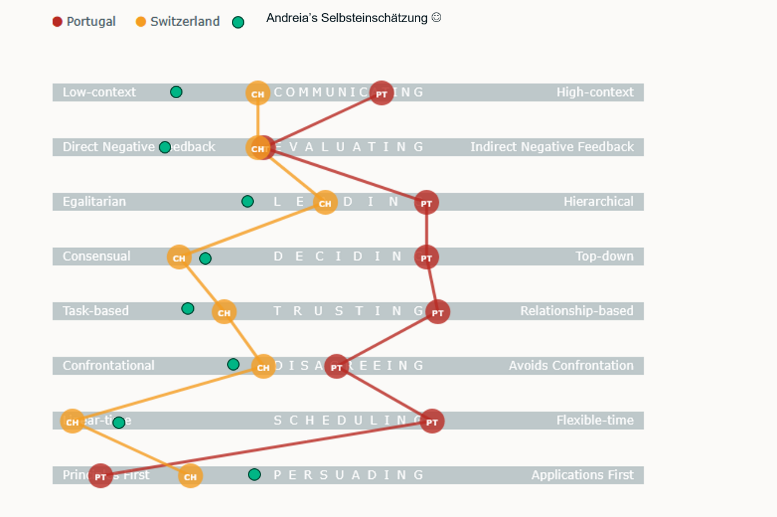
Andreia Fernandes’ own position on the cultural spectrum – Portuguese with Swiss influence, shaping her communication, trust-building, and decision-making.
To make things even more complex: as a Portuguese person, I’m personally extremely direct – which surprises collaboration partners who, going by my name, expect “typically Portuguese” behaviour. Those who know me well know I fondly describe myself as a Portuguese woman with a “Swiss brainwash”: I may be more emotional than the average Swiss woman – but I’m also punctual and reliable to a fault.
2. The Trust Paradox
You’re a project lead.
Your task is clear: the work needs to get done. You check whether the team member delivered what was promised. Then you build on it – and maybe celebrate with an after-work beer.
That’s European-Swiss logic. Task first, relationship second.
In China, it works the other way around. A shared dinner before the project starts isn’t wasted time – it’s the foundation for real collaboration. Without relationship, there’s no genuine trust. And without genuine trust, the project becomes hard work.
That doesn’t mean you now have to invite everyone to dinner. But it does mean: if you only look at the task, you’re missing half the picture.
And when the project fails, you ask yourself afterwards: “Why didn’t anyone flag a problem earlier?”
The answer: because the relationship wasn’t strong enough for anyone to voice their concerns.
3. The Decision-Making Gridlock
You’ve called a meeting. You want a quick decision.
Your German colleague wants to discuss and wants clarity.
Your Swiss colleague is ready to decide quickly.
Your Indian colleague looks at the hierarchy – who in the room actually decides?
Your Japanese colleague wants a consensus process (nemawashi), where everyone is consulted beforehand.
The result: the meeting runs an hour longer than planned. Everyone is frustrated, and no one truly agrees with the decision.
Recognize this from your own meetings? Let’s find out what’s really going on in your team.
Book a free 30-minute consultationThe Webinar: A Practical Look
Watch the recording of a recent webinar – filmed live during one of our workshops on intercultural collaboration. It’s in German, but it gives you a genuine feel for the interactive, practical style of the session; English-language workshops are available on request.
Video length: approx. 45 minutes | Live workshop: “Directness versus Diplomacy in International Teams” (recorded in German)
What Changes When You Build Intercultural Competence in Your Team?
Concrete improvements in everyday work:
Better conflict resolution: once your team understands why people react differently, friction stops being personal. A conflict becomes a cultural tension – and that’s solvable.
Faster decisions: you adapt your decision-making process to your team’s composition. With a highly direct team, you move faster. With a highly relational team, you invest time in alignment up front. Both work – once you do them deliberately.
More psychological safety: people speak up about problems sooner when they know their background is understood. That means mistakes surface earlier. Risks become visible earlier.
Higher productivity: teams that collaborate well are simply faster. That’s not a soft claim – it’s measurable.
Want these results for your team? Let’s talk it through.
Book a free 30-minute consultationTrusted by


The Secret: Awareness, Not Rules
You don’t need to understand a culture perfectly. You don’t need to know every nuance.
You just need to become aware that it’s there.
If you know your German team member is direct because that’s normal within German culture – not because they’re inconsiderate – you can handle it better.
If you know your Italian team member needs a relationship before they truly open up – not because they’re lazy – you can invest the time.
If you know your Asian team member first needs to feel heard – not because they dislike clear decisions – you can structure your meetings differently.
This isn’t complicated.
It’s working differently, on purpose.
The Practical Consequence for Your Team
International teams aren’t the problem. They’re the solution – but only if you shape the collaboration strategically.
What can you do as a leader, concretely?
Who needs more context? Who wants clarity right away?
How should critical points be raised so no one loses face?
Some teams need shared moments before the real work can begin.
Who decides? When are concerns actually heard?
These aren’t new processes. It’s deliberate leadership with an understanding of cultural difference.
What Participants Say
“It was really fascinating, especially how much individual culture influences the way people interact, both professionally and privately.”
Team Leader
“I finally got a real glimpse into the Cultural Map – for me, that’s the key to understanding so much. Thank you, Andreia, as engaging as always! It helped me back then with my Indian manager, after I’d been to India and experienced the culture firsthand.”
Project Manager
“Your presentation and the personal insights were very instructive. I’m looking forward to going through the presentation again and diving deeper. Really useful, thank you!”
Executive
Your Next Step
Most project leads and team leaders are already working interculturally – without realising it. They only notice once it starts to break down.
If you want to strengthen your team – if you want to visibly improve collaboration without having to make every mistake first – there’s a better way.
Intercultural development workshops are built for exactly that. They’re not abstract. They’re not motivational fluff. They’re practical – and meant to be enjoyable!
I work with your actual team on real situations.
Your project leads and team leaders learn how to treat cultural differences as a resource rather than a disruption. How to give feedback without causing harm. How to build trust faster. How to make decisions that people genuinely stand behind.
This isn’t a seminar about culture. This is coaching for how your team actually works together.
What I Offer
Half-day workshops (2 × 4h): for teams starting international projects
Full-day training (8h): for teams with existing friction
3-session coaching (for team leads): individual intercultural leadership development
Custom formats: tailored to your organizational needs
All formats are available online or on-site, delivered in German, English, or Spanish (Portuguese and French upon request), and customized to your team’s cultural mix.

Ready to Transform How Your International Team Works?
Whether you need a half-day workshop, a full-day training, or ongoing coaching for your team lead – I’ll tailor the format to your team’s cultural mix and current challenge.
👉 Book a free 30-minute team consultationNo commitment, just clarity.
“After Andreia’s workshop, our cross-cultural project team finally had a shared language for what had been going on for months.”
Because good collaboration isn’t luck. It’s intention.
Building Trust. Sparking Change. — Andreia Fernandes
Evolution needs action, not autopilot. Get my occasional inputs – keynotes, projects, events, and sharp insights at the intersection of leadership, innovation, and strategy.