
Elements of facilitation that make workshops work
(And What Great Facilitation Actually Looks Like)
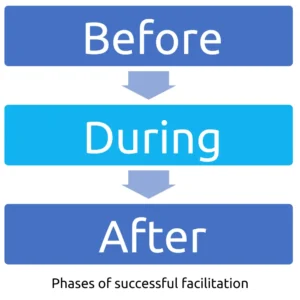
If you want workshops that actually move people from talking to doing, focus on three phases in your preparation:
- Before: get crystal clear on the purpose, align on the one question you’re solving, and set expectations early (especially when the topic is complex or tensions are in the room).
- During: design for interaction (not just “popcorn” discussion), vary interventions to include quieter voices, use tools like a Parking Lot to stay on track, and manage the room’s energy—while staying flexible when the group needs it.
- After: turn insights into commitments (who will do what by when), agree on the next touchpoint, and document outcomes so decisions and learnings are easy to find and follow up on.
Over the past decade, I’ve had the honor of being entrusted by amazing clients to facilitate strategy processes and support teams in developing solutions for strategic problems. Along the way, I also learned a lot from experienced co-facilitators.
In my last post, I wrote about why there are so many bad facilitators – based on first-hand experience and the frustration of observing how facilitation is often confused with personal opinion, and how diverse perspectives are not integrated well.
It’s easy to talk about what can go wrong. But as an optimistic person who genuinely enjoys constructive dialogue, I’ve also spent time reflecting on what makes facilitation great. Here are the elements that consistently make workshops work.
Before: build the foundation
Everyone can become a great facilitator. You too!
Facilitating is a skill – which is good news, because skills can be trained.
And facilitation is less about you and your expert knowledge but much more about activating the collective intelligence of everyone in the room – each with his and her state of knowledge and experience.
What should a good facilitator bring to the table?
- Mindset: optimistic, people – first
- Skills: reading the room, structuring, improvising
- Methods: interventions, decision capture
In practice, that often looks like this:
- A genuine passion for connecting people and perspectives – and a sense for how much impact that can have on solution quality
- Empathy and the ability to read the room while actively listening
- A solution – oriented, constructive optimism (sometimes you’ll be looking for the smallest millimeter of common ground – and it matters)
- Strong organization and a love for designing sessions in different scenarios
- The ability to improvise and stay calm when the workshop takes an unexpected turn (this is not a contradiction to the above – it’s a complementary strength)
- Creativity: With this one I am clearly biased, as creativity has been my top character strength over decades now. But with everything above and the ablility to not just improvise but actually come up with out – of – the box suggestions you’re in a clear advantage. Not for “fun activities,” but for finding out – of – the – box ways to unlock insight, shift stuck dynamics, and build momentum once trust is established.
“Frame the question – and know when to deviate.”
Even if you “start smart” as mentioned in my previous post, there’s another early factor that can make or break a session:
framing the question with absolute clarity.
Make sure everyone understands:
- what you will spend time on
- what is explicitly out of scope
In a perfect world, this is communicated well in advance and reflected in the agenda. During the workshop, it’s your job to bring the group back on track when discussions drift away from the original goal.
Questions shape the direction and depth of any conversation.


A simple tool that helps here is the Parking Lot
Introduce a flipchart (or a wall space) at the start of the workshop where you “park” important topics that are not for today. If you don’t have enough flipcharts, you can use electrostatic notes (often called Stattys).
During: design for participation and manage the energy
Enable interaction early – and regularly:
and through a variety of interventions.
If needed, have a short 10–20-minute call with each participant ahead of the workshop. I do this when the topic is complex, when the team is new, or when I sense tensions.
Then, during the workshop, design for participation – not just discussion.
If you rely on a “popcorn” conversation, you’ll usually hear from the same few voices. If you want the most introvert person to participate as much as everyone else, you need structure.
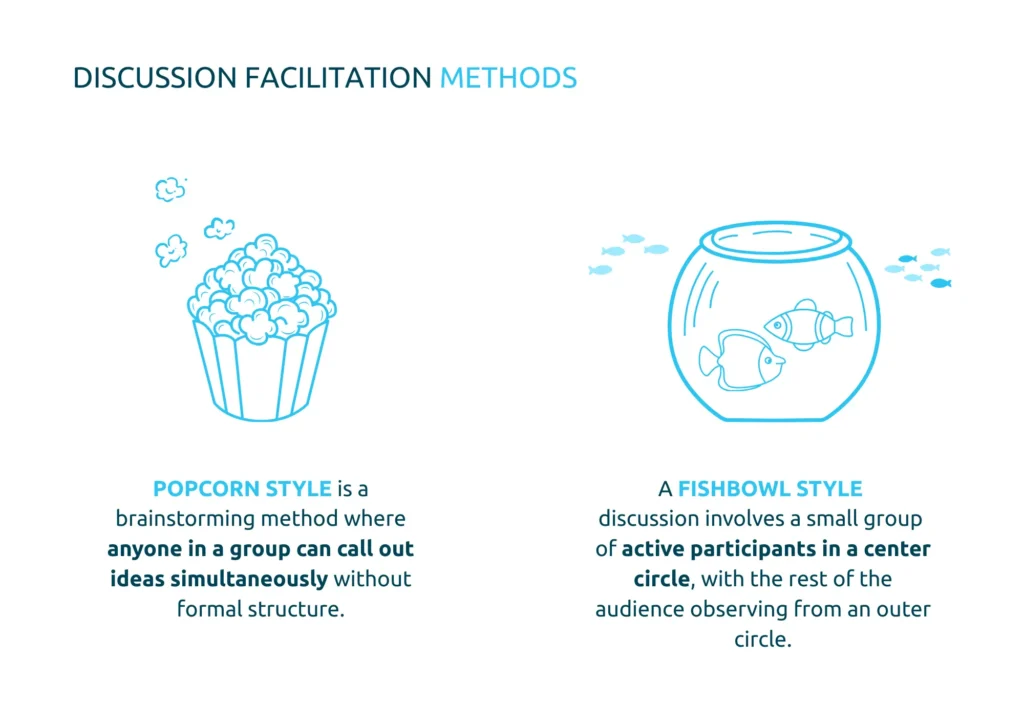
Depending on group size and topic, you can:
- use a fishbowl – style conversation
- ask people to write their contributions first (post – its, cards, shared doc)
- rotate speaking turns intentionally
A simple early intervention (especially for complex topics) is to ask everyone to write one post – it with their expectations.
The framing matters. Instead of “What are your expectations?”, try:
“When we walk out of here tonight, what must have happened for this to be a really good workshop for you?” Andreia Fernandes
Vary interventions (and curate the format)
Curating content – and choosing the right format so people stay engaged – is one of the hardest and most important parts of facilitation.
I’ll mention a few interventions throughout this post, and I’ll dedicate a separate post to interventions and interaction design soon.
One tool that helps me a lot is SessionLab. It helps me keep timing realistic and maintain a library of tested activities. I can plan sessions, store a backlog of interventions, and quickly adjust the agenda without losing the overall flow.

People over plans: Sense the energy in the room:
If the topic is intense, more is more when it comes to taking breaks and creating space “between” the discussions. Depending on group size the break can be the opportunity that allows two participants to clarify something small that isn’t relevant for the whole group, but still matters for trust.
And sometimes you don’t even need a break – just a shift in energy:
- ask people to stand up
- change the location in the room
- switch from talking to writing
- move from plenary to pairs or small groups
A personal anecdote: I once worked with a co – facilitator (assigned by the client) during a global event with more than 50 people. I started the lunch break a few minutes early – at 11:53 instead of noon – because you could literally feel the jetlag and exhaustion in the room. She strongly disagreed. The client, however, saw that I prioritize people over plans – and continued to book me for years.
After: Wrap up so progress continues
End smart: The art of wrapping up:
How you close a workshop determines whether anything actually happens afterward.
Whether it’s a one – off session or part of a longer series, it helps to end with actionable steps so the end of the session becomes the beginning of the next phase.
Key questions:
- Who will do what by when?
- When will you reconvene?
- Where will outcomes and decisions live so they’re easy to find?
Ways to wrap up:
- Commitments with oneself: a letter to oneself (handwritten if possible), or tools like futureme.org
- Commitments with others: peer groups or mentoring groups that agree to follow up
A knowledge hub: a shared space for insights, decisions, and materials (keep it simple and safe – who has access?)
Practical tools I often use:
- A dedicated subpage on my WordPress website
- Clickup page (Thank you Birte 😉 I went from hating it to finding it really useful)
- Padlet.com
And having mentioned the contact point in time and person, the next important point is of course how to collect the key takeaways.
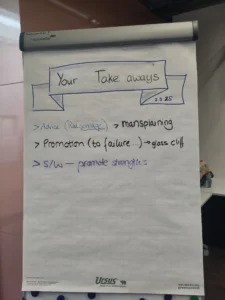
Andreia’s Pro Tip:
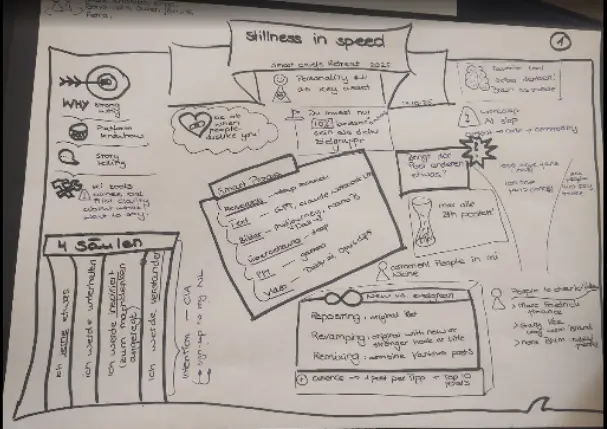
“When I facilitate multi – day workshops, I always also add the date and page number to each flipchart, so after the workshop I still have an order in which the documentation can be tracked.”
When you’re documenting a multi-day workshop with 50+ boards, your future self will thank you for making the ‘story’ of the workshop easy to reconstruct in minutes!”
Possible Frameworks to wrap up a workshop
My favorite framework to wrap up, particularly because it allows to integrate all perspectives of constructive feedback and works in so many different cultural contexts, is the “Handfull of Feedback”
Others are for example Start.Stop. Continue or Now – New – Next
Don’t forget documentation
At minimum, create a photo protocol with photos of all key flipcharts and outputs.
Ideally, capture decisions in a simple decision protocol so outcomes don’t disappear after the workshop.
Add the date and session number or page number to the corner of every flipchart or digital board as you go.
Let’s make your workshops work
If this article resonated, you’re probably looking for workshops and meetings that feel focused, human, and actually useful.
I support teams and organisations in designing and facilitating sessions where people engage, think together, and move forward with clarity, without overcomplication or wasted time.
If you’re planning a workshop, strategy session, or conversation that needs structure and presence, I’d love to connect.

Let’s talk!
If you’re planning an important workshop, strategy retreat, or team offsite and want to make sure it delivers real outcomes – let’s talk.
I help organizations design and facilitate sessions that engage people, unlock ideas, and create ownership.
Reach out to me if you want your next workshop to actually work.
I’m a facilitator, lecturer, and leadership coach with over a decade of experience helping teams and organizations collaborate more effectively.
I combine my background in strategy, positive psychology, and higher education to design sessions where people connect, contribute, and create impact – without endless slides or one-way conversations.
Some links are affiliate links – this means that I have extensively worked with the tools or materials and REALLY think they are great! Iif you use them, I may earn a small commission, this is at no extra cost to you.
SessionLab
Magnetic Cards
STATtys (electrostatic sticky notes)
Perplexity
Evolution needs action, not autopilot. Get my occasional inputs – keynotes, projects, events, and sharp insights at the intersection of leadership, innovation, and strategy.